Rhyme Schemes in Pop Songs: What 2025’s Billboard #1s Actually Use
Most rhyme-scheme guides hand you the same five letters (AABB, ABAB, ABBA, monorhyme, free verse) and stop there. That’s a music-theory worksheet, not an answer to what’s working on the chart this year. Pull the actual 2025 Billboard Hot 100 #1s (Wikipedia’s running list tracks them week by week) and the picture narrows fast.
The pattern after a hand-tagging pass: AABB couplets win the hooks. ABAB carries the verses when there is one. Monorhyme, the same end-sound across an entire section, is doing more work than any songwriting textbook gives it credit for. And the songs that actually went #1 in 2025 are mostly using two or three of these inside one song, not picking one and committing.
This piece walks through five 2025 #1s, tags the schemes by hand, and calls which ones are load-bearing.
Try it free: Drop your half-written hook into Studio AI’s lyric tools and let it suggest end-rhymes against your existing lines. Helpful when you’ve already locked the first two lines and need the third to land. Finish Your Song Free
The Five Schemes Worth Knowing
Before the song-by-song tags, the working vocabulary:
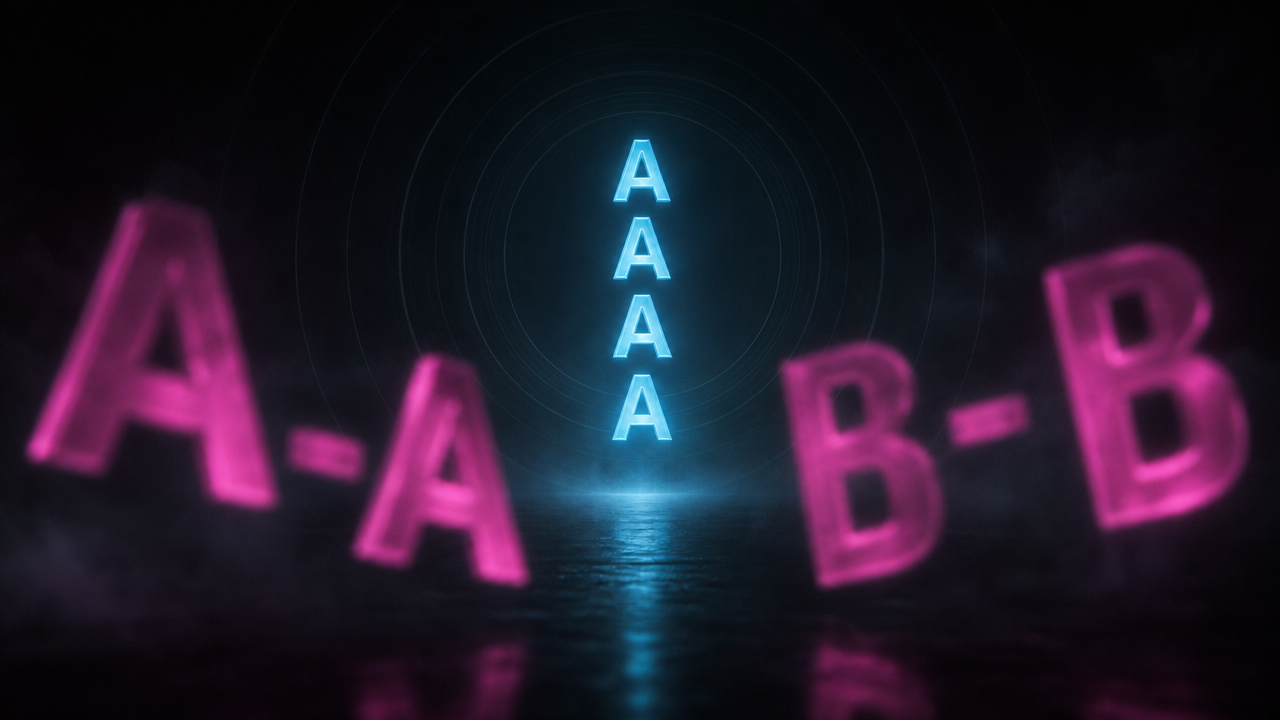
- AABB — couplets. Lines 1+2 rhyme; lines 3+4 rhyme. The most common scheme in pop hooks because the pay-off lands every two lines.
- ABAB — cross-rhyme. Lines 1+3 rhyme; lines 2+4 rhyme. Reads more sophisticated, lower density, common in verses.
- ABBA — enclosed. Rare in pop. Bookends a thought.
- Monorhyme (AAAA) — every line ends on the same vowel sound. Hypnotic, stacks emphasis. Rap uses it constantly. Pop hooks use it for the chorus payoff line.
- Free verse / mixed — refusing the scheme on purpose, usually because the line lengths are doing the rhythmic work instead.
Real songs almost never run pure. The interesting question per song isn’t which scheme but where the scheme breaks, because the break is usually where the hook lives.
”Die With a Smile” by Lady Gaga and Bruno Mars
Verse scheme: ABAB. The verses set up “I just woke up from a dream / where you and I had to say goodbye” with cross-rhymes on the long-I sound. The verse cadence is conversational; the rhymes are unobtrusive on purpose.
Then the chorus collapses the scheme into monorhyme on “you”: “I’d wanna be next to you” repeated four times across the section, with the lines in between resolving back to the same end-sound. This is the load-bearing move. The verse’s careful ABAB earns the monorhyme payoff, because the ear has been tracking variety and now gets repetition. The repetition reads as resolve, not laziness.
Tag: ABAB verse, monorhyme chorus.
”Luther” by Kendrick Lamar and SZA
The interpolation of Luther Vandross’s “If This World Were Mine” sets the rhyme bed. SZA’s parts run cleaner ABAB. The long melodic phrasing favors cross-rhyme because the rhyme pairs have time to breathe across two lines.
Kendrick’s verses move into AABB couplets with internal slant rhyme. He compresses two rhymes per line where the pop singer used one per couplet. That’s the genre tell: the song is technically a rap-pop duet, but the rhyme density splits along the genre line. Couplet density is what gives Kendrick’s section forward momentum against SZA’s slower lyrical resolve.
Tag: ABAB (SZA) against AABB with internal slants (Kendrick). The contrast is the song.
”Not Like Us” by Kendrick Lamar
Year-end #1 territory and the structural antithesis of “Die With a Smile.” This is dense AABB couplet rap with multisyllabic rhyme chains. The hook (“they not like us”) is functionally monorhyme on the -us sound, repeated to the point that the listener stops parsing it as rhyme and starts parsing it as a chant.
The Cambridge “typology of hooks in popular records” (Burns, 1987) classifies this kind of repetition as a rhythmic hook: repetition pushed past the threshold where listeners process the words and into where they process the pattern. “Not Like Us” runs the entire hook on that mechanic.
Tag: AABB couplets with monorhyme hook. The chant is the rhyme scheme.
”I’m The Problem” by Morgan Wallen
Country-pop crossover from the year-end #1 shortlist. The verses run textbook AABB couplets. The country songwriting tradition leans on the couplet because it pairs cleanly with the strophic verse-chorus form, and Wallen’s writing camp has been shipping this exact shape for the better part of a decade.
The chorus does something country pop almost always does: it doesn’t change scheme, it changes line length. Same AABB, but the chorus lines are shorter and the rhymes hit faster. Rhyme density goes up without the pattern changing. That’s the move that registers as “more chorus” without anyone consciously noticing the writer didn’t switch tools.
Tag: AABB throughout. The compression in the chorus is the hook, not a new scheme.
”It’s ok i’m ok” by Tate McRae
Pop-electronic ballad mode, 2025 chart staple. Verses run ABCB: only the second and fourth lines rhyme. This is the laziest-feeling scheme on paper and also one of the most common in modern pop, because it lets the writer drop in a non-rhyming line wherever the storytelling needs it. ABCB is the get-out-of-rhyme-jail card.
Chorus tightens to AABB monorhyme-adjacent repetition on the title phrase. The unrhymed verse lines accumulate tension; the chorus discharges it by rhyming everything against itself.
Tag: ABCB verse, AABB hook. The unrhymed verse line is the trick. It lets the lyric breathe before the hook closes the loop.
What This Tells Us
A 2017 Pudding study on Billboard repetition trends found that lyrical repetition (the same words returning at the same rhythmic point) has been climbing across the Hot 100 since the late 1950s. The 2025 #1s are the continuation of that arc: monorhyme and chant-style hooks aren’t a stylistic accident, they’re the highest-converting pop structure of the streaming era.
Working takeaways from tagging these by hand:
- AABB is still the most common scheme in 2025 chart-toppers, especially in choruses and country crossover writing. Don’t fight it. It works because two-line resolution lands inside the listener’s working memory.
- ABAB belongs in verses where the singer has melodic time to spread the rhyme pair across two lines. Try it when your verse is feeling claustrophobic.
- Monorhyme is the chorus weapon. Repeating the same end-sound past the threshold of “this is rhyming” and into “this is chanting” is what makes a 2025 hook stick. “Not Like Us” and “Die With a Smile” both do it. They are not stylistically similar songs.
- The interesting move is almost always the scheme change at the section boundary, not the scheme itself. Verse ABAB to chorus monorhyme. Verse ABCB to chorus AABB. The contrast is where the hook lives.
If your chorus isn’t landing, the diagnostic question isn’t “what rhyme scheme is this?” It’s “what scheme did my verse use, and is my chorus doing something different enough?”
Finish the Song You’re Writing
Pick a verse scheme that lets the line breathe (ABAB or ABCB) and a chorus scheme that hammers the resolution (AABB or monorhyme). That’s the structural recipe behind most of the songs that hit #1 last year.
When you’ve got the rhyme architecture right and the lyric is ready, the next move is hearing the song without spending three days on demos. Studio AI’s music generator builds a full track from your lyrics, so you can hear the rhyme architecture in context and revise from there.
Frequently Asked Questions
What is the most common rhyme scheme in pop songs?
AABB, or rhyming couplets, is the most common scheme in pop song hooks. It works because the rhyme resolves every two lines, which lands inside the listener’s working memory and makes the line feel finished. ABAB cross-rhyme is the next most common, mostly in verses.
Do modern pop songs even use rhyme schemes?
Yes, almost universally. The 2025 Hot 100 #1s tagged in this piece (Lady Gaga and Bruno Mars’s “Die With a Smile,” Kendrick Lamar’s “Luther” and “Not Like Us,” Morgan Wallen’s “I’m The Problem,” Tate McRae’s “It’s ok i’m ok”) all use identifiable schemes. The convention has loosened (ABCB and free-verse passages are more common than they were in the 1980s) but the scheme is still load-bearing.
What’s the difference between AABB and ABAB?
AABB is couplets: lines 1 and 2 rhyme, then lines 3 and 4 rhyme. ABAB is cross-rhyme: lines 1 and 3 rhyme, lines 2 and 4 rhyme. AABB resolves faster and feels punchier; ABAB feels more elegant and gives the writer more room to develop a thought before the rhyme lands.
What is monorhyme and why does it work in pop?
Monorhyme is when every line in a section ends on the same rhyme sound. It works in pop choruses because past a certain repetition threshold the listener stops processing the words as rhyme and starts processing them as a chant. The Cambridge “typology of hooks in popular records” by Gary Burns (1987) calls this the rhythmic hook: repetition becomes the hook itself.
Is AI-generated lyric output stuck in AABB?
Often, yes. Large language models default to the most statistically common scheme in their training data, and that’s AABB. If you want ABAB or ABCB, you usually need to specify it in the prompt, and even then the model will drift back toward couplets across multiple verses. The fix is to write the first verse yourself in the scheme you want, then have the AI continue in the same shape.
Where can I see the full list of 2025 Billboard #1s?
Wikipedia maintains a continuously-updated list of Billboard Hot 100 number ones of 2025, week by week. It’s the cleanest free reference for tagging the year’s #1s yourself if you want to extend this analysis.