Lyric Clichés to Avoid (And What to Write Instead)
A lyric cliché isn’t just a phrase that’s been used before. The problem is more specific than overuse: a cliché borrows emotion rather than earning it. It asks the listener to feel something by reaching for a shared association (rain means sadness, fire means passion, roads mean freedom) instead of creating the condition for that feeling in the specific world of the song.
The listener recognizes the shape of the emotion. But recognition isn’t feeling. The song washes over them and leaves no residue.
This matters more right now because AI-generated lyrics are especially prone to cliché. Language models default to the most statistically common patterns in their training data, and song lyrics are full of repeated conventions. If you use AI to generate a first draft and don’t revise aggressively, you’re likely getting prose built from the same phrases every other song uses. The output sounds like a song. It doesn’t feel like one.
The goal of this guide is to identify the most common categories of lyric cliché, explain why each one fails structurally, and give you specific alternatives. Not as formulas, but as examples of the kind of specificity that makes a lyric work.
Weather and Seasons
Weather clichés are the most common in pop and country because they seem emotionally resonant on the surface. Rain, storms, sunshine, winter, spring: these all carry conventional associations that listeners have absorbed through thousands of songs. The problem is that those associations have been flattened by repetition. The listener processes “dancing in the rain” or “dark clouds rolling in” at the level of symbol recognition, not feeling.
Clichés in this category:
- “Dancing in the rain”. Joyful defiance at first, but now signals nothing beyond “I am feeling an emotion in inclement weather.”
- “Dark clouds rolling in”. The storm as metaphor has been fully mapped to trouble/struggle. There’s nothing left to discover here.
- “Sunshine after the rain”. Recovery framed as weather. Implies the storm is over without telling us anything about the person who survived it.
- “A chill in the air”. The physical sensation that signals emotional distance or coming change. Used so often it has no signal left.
- “It’s a cold December night”. The winter-as-loneliness framing. The calendar date does no work; any cold month would serve the same function.
The alternatives aren’t about finding a less-used weather metaphor. They’re about either going deeper into the physical specific or abandoning the weather entirely for something more particular. Instead of “dark clouds rolling in,” what’s the actual sensation of that dread? Is it the way a room goes quiet before an argument? The three seconds before a text message comes back wrong? Find the physical detail that creates the weather feeling without reaching for weather.
Heart Metaphors
The heart as a symbol for feeling has been in English-language poetry for centuries and in popular song for as long as there has been popular song. It’s not inherently bad. It’s so culturally embedded that it sometimes lands. But most heart clichés fail because they’re abstract: they point at the idea of feeling rather than producing the feeling in the listener.
Clichés in this category:
- “My heart is breaking”. Names the condition without rendering it.
- “Heart of stone”. Emotional unavailability as geology. Too distant from anything human.
- “Follow your heart”. Motivational poster as lyric. No specificity, no tension.
- “You hold my heart”. Ownership metaphor. Has been used in virtually every ballad since the 1950s.
- “Pieces of my heart”. Fragmentation metaphor. Same as “breaking” with added imagery.
- “You make my heart race”. Physical response named without being rendered.
What works instead: render the specific physical sensation or behavior that tells us the heart is involved without naming the heart. The hands that won’t stop moving. The sentence you keep typing and deleting. The way you clean the house when there’s nothing left to do. These tell us about a heart without borrowing the symbol.
Dependency Tropes (“I Need You Like…”)
The “I need you like X” construction is a simile that’s supposed to illuminate the quality of need through the comparison. The problem is that the comparison items have become standardized: air, water, oxygen, the sun, breathing. These aren’t comparisons anymore. They’re a template. The listener fills in the blank before you’ve finished the line.
Clichés in this category:
- “I need you like I need air to breathe”. The most common version. The listener has heard this in some form in hundreds of songs.
- “I can’t breathe without you”. Oxygen dependency as love. Now also a phrase with different cultural weight that can land wrong.
- “You’re my everything”. Maximum dependency, zero information. What is the everything?
- “Without you I’m nothing”. Same problem. Nothingness is abstract.
- “You’re the only one who understands me”. Isolation framing that’s true for everyone who has ever been in love, which means it’s true for nobody in particular.
- “I’d be lost without you”. Geographic metaphor for existential need. Lost where? Doing what?
The fix is to make the comparison strange and specific. “I need you like” should complete with something that tells us about the speaker’s particular life, not a universal biological function. The specificity is what creates the feeling of truth. If the comparison is strange enough to pause a listener, it’s probably doing its job.
Light and Darkness
Light as hope/clarity/truth and darkness as despair/confusion/evil is one of the oldest symbolic frameworks in human language. In lyrics, this has been compressed into a handful of phrases that carry almost no meaning because they’ve been used to mean everything.
Clichés in this category:
- “You are my light” or “you light up my life”. Hope projected as illumination. Inert.
- “I’m drowning in the dark”. Two clichés for the price of one. Darkness plus drowning.
- “Guiding light”. Navigation metaphor. Used from gospel to pop to country.
- “See the light at the end of the tunnel”. Optimism as architecture. The tunnel is so familiar it generates nothing.
- “In the darkness I found you”. Discovery in difficult circumstances rendered as visual metaphor.
- “You’re my beacon”. Navigation metaphor, variant.
Light and dark can work when they’re concrete rather than symbolic. The specific quality of a particular light in a specific place — the yellow of a streetlight on wet pavement at 2 AM, the brightness of a hospital hallway at noon — carries emotional information because it’s real. The abstract light/dark pairing carries none.
The Road and Journey Metaphor
The road has been used to mean life, decision, freedom, departure, arrival, and return so many times that it now means all of them at once, which means it means none of them specifically. The journey metaphor is similarly overworked: life as a journey, the path forward, crossroads, the destination versus the distance traveled.
Clichés in this category:
- “Life is a journey”. The foundational cliché of the metaphor set.
- “At a crossroads”. Decision framing as geography. Inert.
- “The long road home”. Return as distance. Works only when the road is specific.
- “I’ve been down this road before”. Repeated pattern framed as travel.
- “On this journey we call life”. Both metaphors, stacked.
- “The road less traveled”. Now carries Frost baggage and also functions as a cliché independent of the poem.
Travel works when it’s literal: an actual road, an actual departure, a specific destination that tells us something. The metaphorical versions require replacing them with the actual decision, the actual return, the actual pattern being repeated.
Time Clichés
Time-as-healer, time-as-currency, and time-as-enemy are the three most common frameworks for time in popular lyrics. All of them have been fully elaborated across decades of pop music, which means they land as templates rather than as observations.
Clichés in this category:
- “Time heals all wounds”. The definitive time-as-healer statement. Rarely true, always used.
- “Running out of time”. Urgency framing. The clock metaphor for deadline pressure.
- “Time flies”. Observation about duration. Zero lyrical information.
- “It feels like forever”. Duration distortion framing.
- “Turn back time”. Regret as temporal navigation. Used in enough songs that it now references other songs.
- “These days / back in the day”. Temporal contrast framing. Works only when the contrast is specific.
Time is most effective in lyrics when it’s measured in something other than time. Not “years went by” — what happened in those years? Not “time heals” — what specifically feels different, and how? The texture of time is more interesting than its passage.
Auditing Your Own Lyrics
Reading your lyrics back for clichés is hard because you’re close to the material. The phrase that feels true to you is often doing so because it’s carrying familiar cultural weight rather than genuine specific truth. A few techniques help.
Read the lyric aloud and flag any phrase you’ve heard before. Not just in your own songs, but in any song, in casual speech, in cards and posters. If the phrase is at home in any of those contexts, it probably lacks specificity.
Ask whether each image could appear in 100 other songs. If it could, it’s doing generic work. The image needs to be strange enough that it could only appear in this song about this situation.
Try replacing every abstract noun with a concrete one. “Pain” becomes the specific sensation of pain in this specific situation. “Love” becomes the behavior that demonstrates love. “Time” becomes the specific measurement of time that matters here.
The Suno Lyric Cliché Checker runs your lyrics against a database of common cliché patterns and flags the phrases most likely to be working against you. It’s useful for a fast first pass before you do the deeper revision work. It catches the obvious targets quickly so you can spend your revision time on the ones that require more judgment.
The Underlying Problem with AI-Generated Lyrics
AI music tools generate lyrics by pattern-matching against a training corpus that’s heavily weighted toward existing, successful songs. The most successful songs contain the most-used phrases. That means AI-generated lyrics default toward the center of the phrase distribution: the statistically most common way to say a thing. Which is, by definition, a cliché.
This doesn’t mean AI-generated lyrics are useless. It means they require aggressive revision. A first draft from an AI tool is a structural scaffold, not a finished lyric. The specific phrases (especially in any emotional peak, hook, or bridge) need to be interrogated and replaced with language that could only belong to this song.
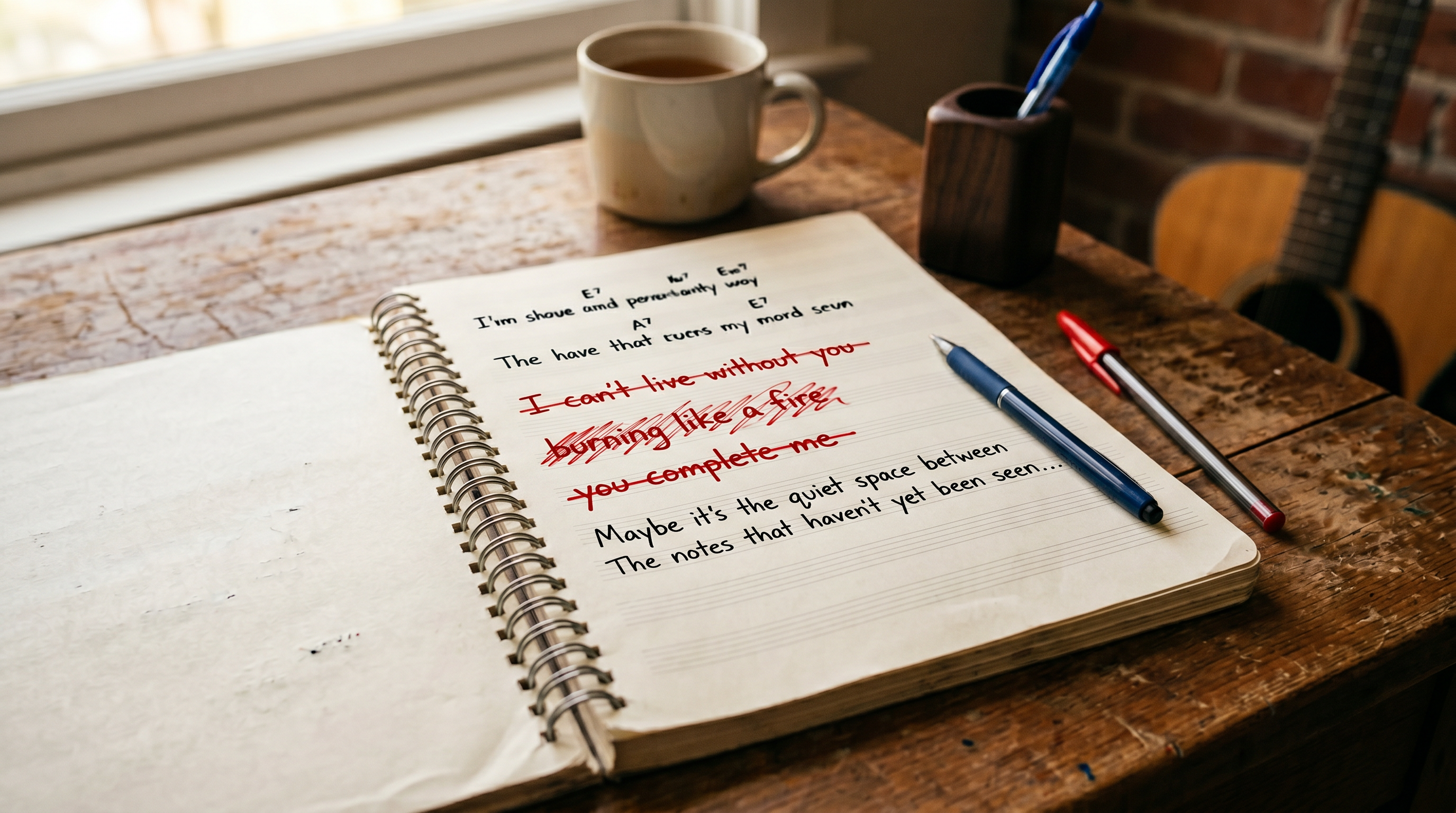
The pattern of “rain = sadness,” “fire = passion,” “road = life” isn’t in the AI’s output because it’s poetic. It’s there because it’s statistically dominant. Your revision job is to replace statistical dominance with actual feeling.
Generate Your First AI Track Free, then use what’s here to revise the lyrics into something that actually sounds like you.